With the rapid evolution of the job market, more and more Algerian professionals, particularly in the IT sector, are wondering: should we remain employed or go freelance?
This choice has major impacts on income, taxation, social security contributions, retirement, health coverage and risk management.
Here is a realistic analysis to help you compare the two statuses in Algeria.
Financial comparison: employee vs freelance in Algeria
Situation of the IT employee
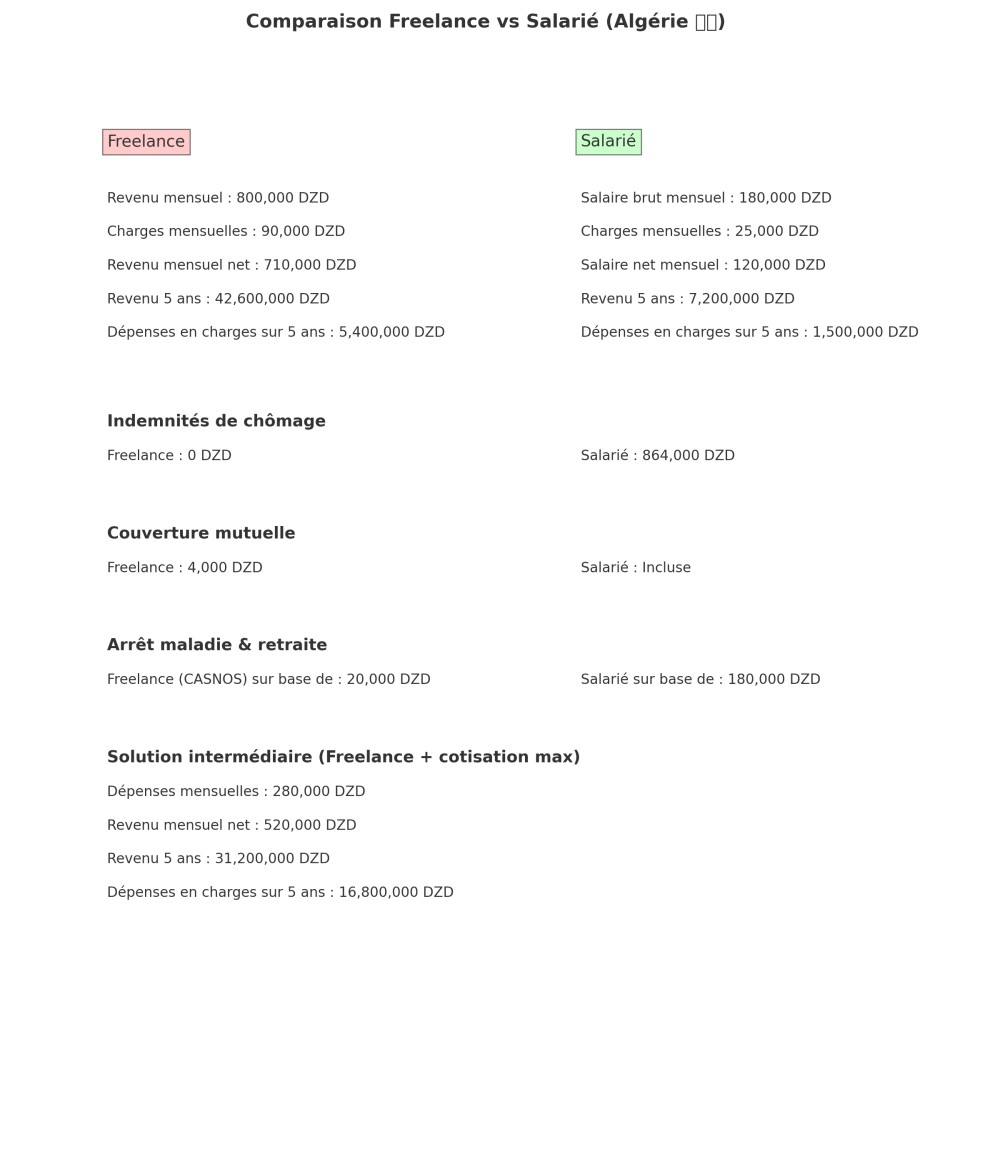
Let's take the example of a salaried developer in Algiers with a gross monthly salary of 180,000 DZD (around €1,200), which corresponds to a confirmed profile.
Its monthly charges:
-
Internet: 2,000 DZD
-
Telephone: 1,500 DZD
-
Electricity: 1,000 DZD
-
Transport: 10,000 DZD
-
Other personal expenses: 20,000 DZD
Net salary after taxes and social contributions (CNAS + IRG) is around 135,000 DZD.
Net monthly income after personal expenses: around 100,500 DZD.
Over 5 years: net income ≈ 6,030,000 DZD.
Situation of IT freelancers in Algeria
Let's take an IT freelancer charging 20,000 DZD per day (a median rate for an experienced freelancer in Algeria) and working on average 18 days per month → 360,000 DZD per month.
Monthly professional charges:
-
Internet: 2,000 DZD
-
Telephone: 1,500 DZD
-
Electricity: 1,000 DZD
-
Coworking or office rent: 10,000 DZD
-
Transport: 10,000 DZD
Or 24,500 DZD of monthly fixed charges.
Social charges:
The freelancer generally contributes to the CASNOS → ≈ 10,000 DZD/monthfor a minimum basis.
Taxation:
-
Simplified IRG: approximately 5% of turnover declared as service activity → ≈ 18,000 DZD/month.
Total social charges + tax: ≈ 28,000 DZD/month.
Monthly net income after charges ≈ 307,500 DZD.
Over 5 years: net income ≈ 18,450,000 DZD.
Income conclusion
Even including professional, tax and social charges, freelancers in Algeria can earn 2 to 3 times more than an employee in an equivalent position, especially if they manage to maintain a stable rhythm of missions.
Unemployment: almost non-existent safety net for freelancers
-
Employee: in the event of dismissal, benefits from CNAS unemployment compensation for a limited period.
-
Freelance: no automatic right. It must provide for precautionary savings in the event of temporary loss of missions.
👉 A prudent freelancer should plan for 3 to 6 months of income in savings.
Health coverage: CNAS vs private insurance
-
Employee: automatically covered by CNAS (basic health insurance, sometimes mutual in company).
-
Freelance: contribution to the CASNOS (basic coverage).
In practice, many freelancers also choose a private health insurance (~5,000 to 8,000 DZD/month).
Freelancer advantage: the contribution can be tax deductible.
Retirement: a key subject for freelancers
-
Employee: automatic CNAS + company contribution → validation of quarters and retirement rights.
-
Freelance: voluntary contribution to CASNOS → minimum pension if you contribute on a low basis.
Recommended strategy for freelancers in Algeria:
-
Contribute to CASNOS on a reasonable basis to validate quarters.
-
Complete with private retirement savings (life insurance, rental property).
Example:
If an IT freelancer contributes 10,000 DZD/month for 20 years, he will validate a low basic pension (~30,000 DZD/month in future equivalent).
→ Hence the interest in strengthening through private savings.
Intermediate solution: pay yourself a “similar employee” income
An option often chosen: a freelancer grants himself a stable “reference salary”:
-
For example: 180,000 DZD/month (same level as an IT employee).
-
He contributes to CASNOS on this basis and pays himself additional income in the form of “profit” from his activity.
Advantage: better future retirement and financial stability.
Disadvantage: less short-term flexibility.
Conclusion
Employee in Algeria:
-
Social security and stability (CNAS, retirement, unemployment).
-
Incomes capped by the salary market.
Freelance in Algeria:
-
Much higher income potential.
-
Total flexibility.
-
Need to properly manage your social security (health, unemployment, retirement).
-
Need to anticipate off-peak periods.
In summary:
👉 Salary employment is reassuring for those who prioritize stability.
👉 Freelancing is attractive for those who wish to boost their income and their freedom, provided they prepare their protection well. social and their cash flow.
What DZFreelance offers to secure freelancers
-
Automated social security contribution reminder.
-
Help in choosing private health insurance.
-
Practical guides for preparing for retirement as a freelancer.
-
Help in managing precautionary savings.
-
Points system to move up in research and secure a flow of missions.